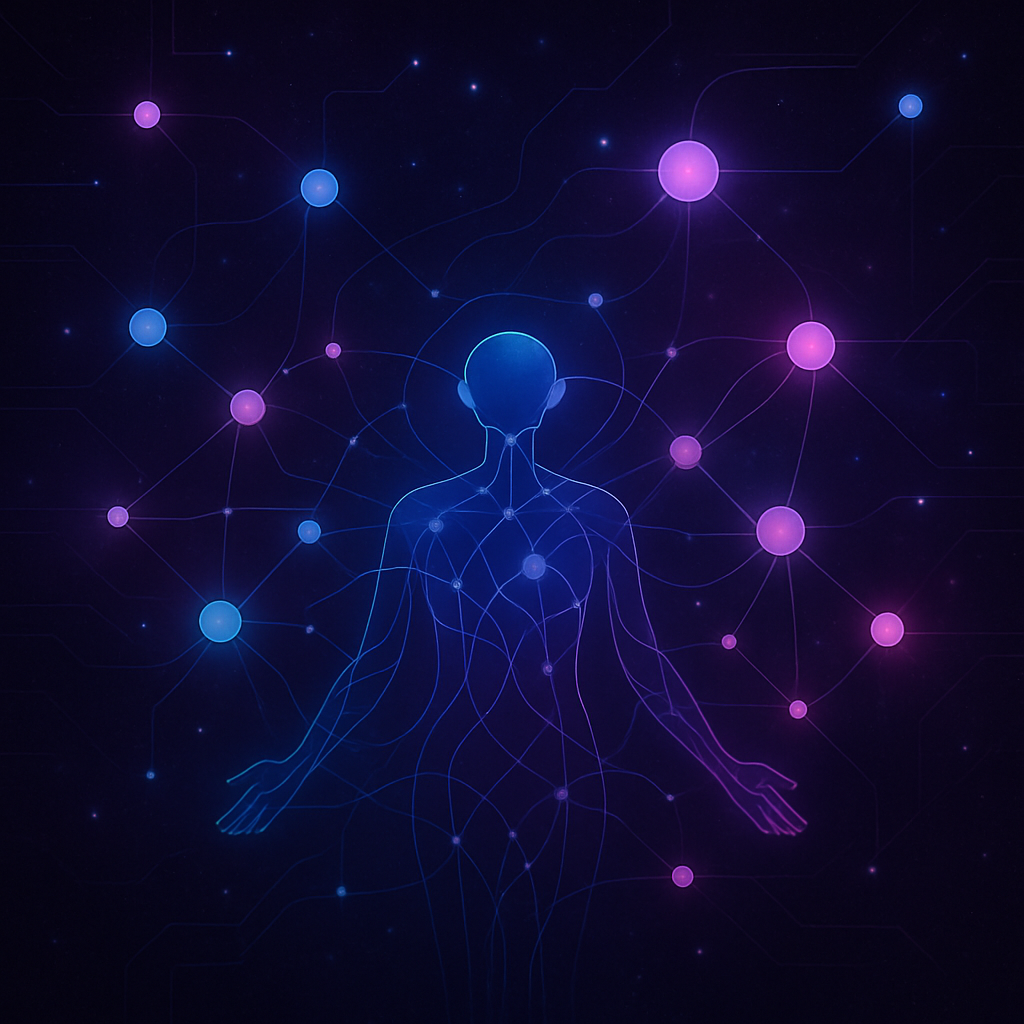
Lately I’ve been thinking a lot about how we connect online. It feels like we all scroll through much the same posts. At times we get stuck in our own echo chambers. It makes me wonder if there’s a different way, a deeper way, for us to meet in these spaces. That train of thought led me to an idea I call Quantum Social. It’s a way of seeing the ties we make online as something more alive, something we live through, full of untapped potential. I’m borrowing words from quantum physics as design metaphors. They are not physics, and they are not a tested theory of how people connect.
When I look back at how social media has grown, it’s clear that it has brought us closer in many ways. But it can also feel like we are often just watching from the sidelines, rather than truly taking part. The algorithms, smart as they are, can sometimes lead us down very familiar roads.
We’ve seen this journey unfold:
- From the early excitement of just being online together in the late 90s and early 2000s (with platforms like SixDegrees, Friendster, and MySpace).
- To the growth of major platforms (like Facebook, YouTube, and Twitter). They linked the world and made video a central part of our lives.
- Through the rise of sharing our lives in pictures and quick updates that soon vanish (on Instagram and Snapchat).
- And into today’s world of fast short videos and feeds run by AI (like TikTok and Reels). It’s a constant race for attention. Platforms can sometimes feel more like broadcast channels than places where we get close to each other.
Each step has given us new ways to share. Yet the depth of our ties can get lost along the way. The sheer amount of content, and the constant chase for “likes”, can make the time we spend with each other online feel shallow. I believe many of us want something more. Something that feels more real, draws us in, and truly means something.
What if we thought about connection differently?
What if we tried to rethink the very roots of how we meet online? At its core, Quantum Social holds that each thing we do online has a kind of hidden potential. So does each thing we share, and even each person. That potential waits for us to engage with it and bring it to life. I see it as a new way of looking at how we might build ties.
Let me try to explain what this could mean:
- Content with Many Faces (Superposition) | Imagine if a single post wasn’t just a fixed thing. What if it was more like a wave of possibilities? Based on how you engage with it, it might unfold as an amazing visual story. For someone else, it could become a source of deep information. For another, it might open the door to a group working together. The interesting part is that you wouldn’t just take the content in. The way you engage would help decide what it becomes for you.
- Interconnected Audiences (Entanglement) | What if we weren’t just people scrolling alone? What if engaging with something could truly link us? Picture the kind of system Quantum Social has in mind. In it, a post you engage with might quietly tie you to a whole network of others exploring the same thing. You might share a sense of excitement or discovery, even if you never talk to each other. One person’s good insight could then ripple outwards, a bit like an echo. It could help the whole network feel more understood and upbeat.
- Shaping Our Own Experiences (The Observer Effect) | Suppose each click, share or comment did more than show your interest. What if it helped shape what happens online? And what if the space itself could adapt and grow with the way we all take part? It might feel more like a living conversation. We would all help write the story, instead of just taking it in. We might feel less like visitors and more like co-creators. In this metaphor, the online world would depend on what we do. That would be by design, not because quantum physics says so.
- Bigger, Deeper Shifts In Understanding (Quantum Leaps) | What if this way of thinking led to more than small, step-by-step changes? It might bring bigger leaps in understanding, support and community. If the ties we make strike a chord on many levels, maybe we could see more sudden, positive shifts. People might change in how they feel, and in how they engage with each other and with ideas. Could it spark bigger leaps in how people back the ideas they care about? Might it even make them more loyal to the things they value?
- The Joy of Unexpected Discovery (Uncertainty) | We all know some of the things we like. But what about the passions we haven’t found yet? Quantum Social, as I picture it, would welcome surprise. It wouldn’t only show you what it thinks you want. It could also bring you a wide mix of things you might not expect. That way we could stumble on new interests, brands or communities we never knew we’d love. This could keep our online worlds fresh and exciting.
- Building Stronger Communities (Decoherence to Community) | Picture each of these possibilities, and each way people take part, merging into shared experiences. The aim then isn’t to limit options. Instead, this could be the very way that strong, lively and truly connected communities are built and cared for. Not just lists of followers, but active groups of people who share passions and grow together. Their bonds would get stronger through moments they create and share.
What could this mean for online interaction?
As I think this through, the point isn’t to make things more complex for the sake of it. I believe that exploring something like Quantum Social could lead us down new paths. They could take us to more depth, to ties that feel more real, and to a different kind of energy in our online lives.
Some possibilities that come to mind:
- Experiences that feel uniquely ours, yet shared | Could this lead to time online that feels deeply personal? It might go beyond today’s suggestions, and feel shaped for each of us. Yet it would also draw on what the wider community has learned and done together. That could mean a kind of hyper-personalisation that still feels connected.
- More natural ways for ideas to spread | People might feel a real bond through the times they share. If so, ideas and trust could spread in a more natural and powerful way.
- Stories that evolve with us | Think of content, and even larger campaigns, that aren’t fixed but alive. They would keep changing and growing with how the audience joins in and what it adds.
- Understanding impact in new ways | If the way we engage gets richer, we’ll likely need new ways to see its impact. Maybe we’d look at how deeply people connect, how much shared “aha!” moments matter, or the things communities create.
The world of social media always seems to be looking for what’s next, and for better ways to connect. For me, Quantum Social is about dreaming of an online world where we feel closer, more alive and truly drawn in. That world might be out there, waiting for us to explore and shape it together.
Where do we go from here?
Honestly… I don’t have a crystal ball. Quantum Social, as I’ve laid it out, is still a set of open questions, and a direction to explore. It invites us to think in a new way about how we meet online. It asks if we can build online spaces that feel more alive. Such spaces would respond more to what makes us curious, both alone and together. They would also do more to grow real ties that keep changing over time.
Perhaps the next wave of social will come from a basic shift in how we value and design for the ways people engage. That shift would honour the depth and potential in each tie we make. What if the “next big thing” is not one more feature or a faster feed, but the quality of the entanglement a platform allows?
These are just early thoughts, and a starting point for a much larger conversation. I find it exciting to picture our online worlds growing from static pages into lively, shared realities that we help create.
What possibilities do you see?
Comments