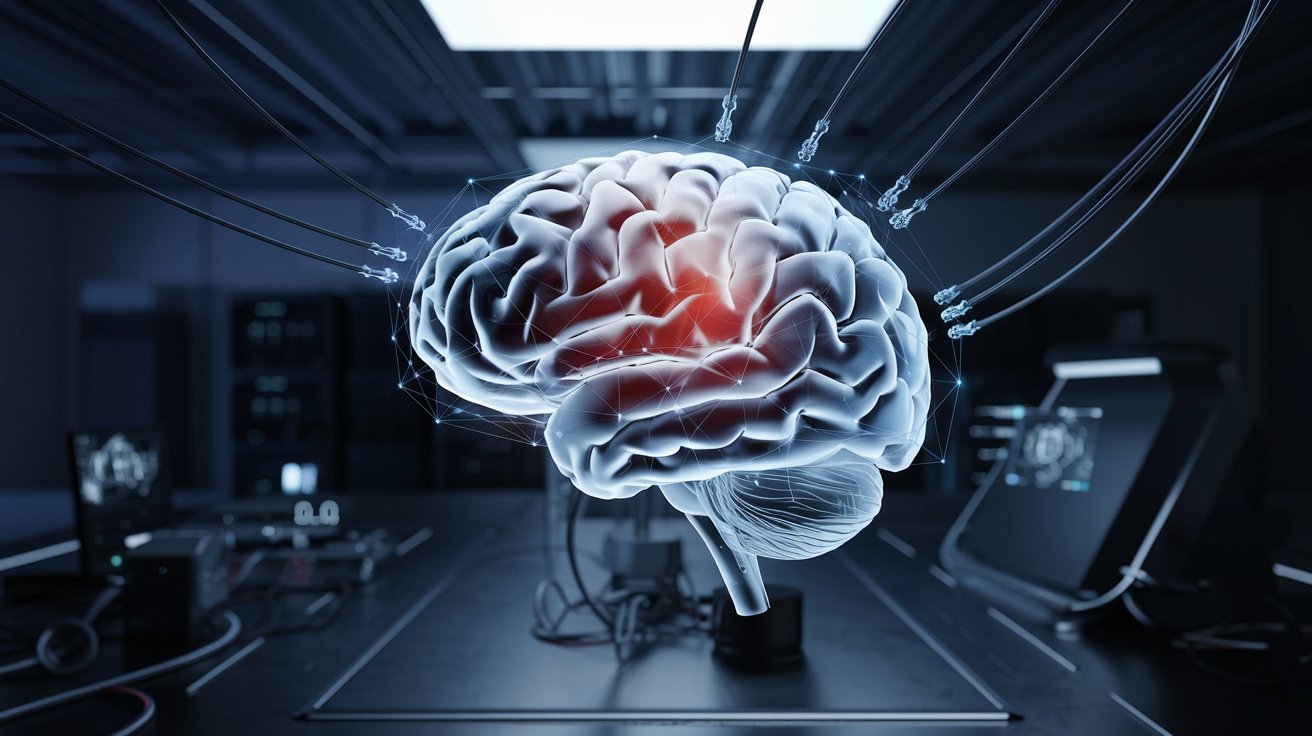
Do you ever get that feeling, your brain’s just buffering? You’re trying to pull up a name, or where you last saw your car keys… it’s the worst, right? But then boom! You grab your phone, and it’s all there delivered as an instant brain boost, courtesy of our favourite tech giants. It makes you wonder, doesn’t it? Are we heading toward a future where our own brains can just… coast? A future where our tech is so good at remembering everything that we just don’t have to even try anymore?
It’s a crazy thought to throw around, especially when you see the mind-blowing stuff happening with computers and how we’re slowly piecing together how the brain actually works. Picture this: you need a fact, any fact, and it just… appears in your head. Like the internet decided to move in upstairs. But wait. Let’s get real about what that could actually mean for us, for how we hang onto our memories. Because it’s a lot more complicated than just shoving data onto a chip and plugging it into your brain.
Quick disclaimer here! I’m just a regular person who enjoys thinking about this stuff. I’m definitely not rocking a lab coat or anything in my day-to-day. I’m just tossing ideas out into the void. If there are any actual brainiacs reading this, please, for the love of science, tell the world the truth! The brain-download future below is speculation, not a capability these tools have shown.
Your Memories: It’s More Than Just a List of Facts, But…
We use the word “memories” like it’s a grocery list. But it’s so much messier, so much more personal than that. They’re part of the weird, wonderful story of you. They shape how you see the world, even the goofy bits. And isn’t it funny? Even when someone’s memory isn’t firing on all cylinders, that need not erase their whole sense of self. Memory loss can still change a person’s life and sense of who they are. They’ve still got their own little quirks and their own way of looking at things. So maybe what makes you you isn’t just a perfect memory bank after all.
And it’s not just the dry facts, is it? It’s the feeling and emotion that gets tangled up in there. That rush of pride when you absolutely aced something? Or that cringe-worthy moment that you’d rather bury in the back garden? That feeling sticks with the memory, and it teaches you stuff that plain facts never could. Tech can try to infer emotions from our tweets and stuff, though it can get them wrong. But can a computer really feel that awkwardness in your gut the way you did? Food for thought.
Learning, Creating, and the Tech Wild Card
So, our own memories are how we learn the basics, no question. Think about learning to tie your shoes – your brain somehow figures out that weird knot thing and remembers it. And when you’re trying to figure something out, you’re usually pulling on stuff you’ve learned before. But here’s where things get a little sideways: computers are getting seriously impressive at spotting patterns and solving puzzles – sometimes they can run circles around us! They learn from mountains and mountains of data, even if their “learning” is a different beast than ours.
And then there’s creativity. We tend to think of brilliant ideas just popping into our heads, outta the blue, shaped by our own weird experiences. But then you see AI spitting out surprisingly cool art or music, and you do a double-take. Maybe there’s more than one way to get to that “lightbulb moment,” and maybe relying just on what’s rattling around in our skulls isn’t the only path. Could be a pretty wild future where human brains and super-smart AI team up on that creative stuff.
Our Brains Are Wired for It, But Our Brains Can Also Change
Yep, our brains are naturally wired to make and hold onto memories – it’s a pretty basic feature. It’s kept us going for millennia. But our brains are also surprisingly flexible. Could your sense of direction go south if you’re always glued to your GPS? Using a tool can change what we practise, but that is not proof that every GPS user loses that skill. If we’re constantly letting our gadgets handle the remembering for us, might our brains start to shift their focus? And while there’s a limit to how much info we can juggle at once, tech keeps finding faster ways to beam information our way. Could be a game-changer. Researchers call using external tools to ease a mental task cognitive offloading. A 2011 study found that expecting later access to information could change what people remembered in controlled tasks. That does not establish that phone use harms memory in general.
The Future: Brains and Tech, a Power Couple?
We’re already dipping our toes in this, right? Our phones are basically external hard drives for phone numbers, those random facts we looked up at 3 AM, and a zillion photos. That’s likely just the beginning of the story. Maybe we’ll see even cooler gadgets or even ways to connect our brains directly to the digital world someday.
But here’s the crucial bit. Even if tech can recall every single fact in existence in the blink of an eye, it’s still us who have to make sense of it all. We’re the ones who connect the dots and decide what actually matters. The future probably isn’t about tech completely erasing our own memories, but more like a fascinating collaboration. Tech can handle the data overload, and we can focus on the messy, wonderful human stuff – understanding, feeling, connecting with each other. Maybe even the very definition of “memory” will evolve as we work more hand-in-hand with technology.
Food for Thought and an Invitation
So, are we all destined to forget our own birthdays one day? Probably not in the way we picture it in some sci-fi movie. The tools we use to remember things are changing as tech gets smarter. What that does to our own recall depends on the task and how we use them. Our own memories are deeply woven into who we are, no doubt. But our brains are also ridiculously good at adapting, and tech is opening up some seriously new possibilities. Maybe it’s less about one winning and the other losing. Maybe it’s more about figuring out how to remember and make sense of the world in new and collaborative ways. It makes you wonder what kind of unexpected brain skills and exciting powers we might unlock on the journey!
Seriously though. These are just my late-night thoughts bouncing around. If you’re someone who actually studies brains or why we do the things we do, I’m all ears. Am I way off in left field here? What mind-blowing stuff am I missing? Let’s kick around what the future of remembering might actually look like!
Comments